


C.D. Howe Institute Monetary Policy Council Calls for Bank of Canada to Hold Overnight Rate at 0.50 Percent through Mid-Year; Hike to 0.75 Percent by September 2016
September 3, 2015 — The C.D. Howe Institute’s Monetary Policy Council (MPC) today recommended that the Bank of Canada keep its target for the overnight rate, the very short-term interest rate it targets for monetary policy purposes, at 0.50 percent at its next announcement on September 9, 2015. Looking ahead, the Council called for the Bank to hold the target at 0.50 percent through to March of 2016 and hike it to 0.75 percent by September of 2016.
The MPC provides an independent assessment of the monetary stance appropriate for the Bank of Canada as it pursues its 2 percent inflation target. William Robson, the Institute’s President and Chief Executive Officer, chairs the Council.
Council members make…
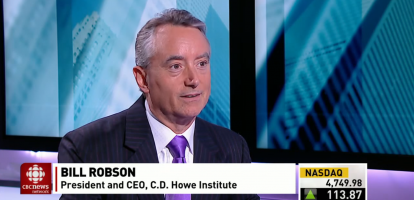
Bill Robson: Best Policy Response to the Recession?
Stephen Gordon: Canada Is Not In A Recession, And That’s A Bad Thing: National Post Op-ed
By Stephen Gordon
Most people probably think of the debate over whether Canada is in a recession as one of those glass-half-full versus glass-half-empty things. Pessimists look at five months of declining GDP and call it a “recession,” while optimists look at increasing employment and say that we’re not in a recession. Yet, the real pessimists are the ones saying we’re not in recession.
Making the case that we’re in a recession is basically optimistic: the problems we’re currently experiencing in the economy will be over soon (if it’s not already) and all that is needed it for policymakers to employ the usual array of countercyclical policies. The “no recession” camp is the home of the pessimists: saying that we’re not in…
Is Canada in recession? These numbers suggest not: Globe and Mail Op-Ed
By Steve Ambler and Jeremy Kronick
Statistics Canada’s release of preliminary merchandise trade figures for June may provide some closure to the debate on Canada’s so-called recession. After a 4-per-cent fall in export volumes over the first five months of 2015, Canada’s sales to foreigners came roaring back, with a 4.8-per-cent increase in June alone. Imports also decreased in volume by 0.9 per cent from May to June.
Overall Canadian economic growth in the first quarter of 2015, as well as the first two months of the second quarter, was negative. The decline in the value of the Canadian dollar in the wake of falling world oil prices had been expected to boost the growth of most other exports, but until June, the…
Too Soon to Call a Downturn
Report of the C.D. Howe Institute Business Cycle Council
July 28, 2015 – Data do not at this time allow declaring whether Canada has entered an economic downturn. This is the consensus view of the C.D. Howe Institute’s Business Cycle Council, which held its second meeting on July 22, 2015.
The Business Cycle Council is the arbiter of business cycle dates in Canada. The council is comprised of eminent economists active in the field, and acts as a conduit for research aimed at developing a deeper understanding of how the economy evolves and to provide guidance to policymakers. Members of the Business Cycle Council participate in their personal capacities, and the views collectively expressed do not represent…
Why Bank Of Canada’s Rate Cut May Have Less Impact Than Poloz Hopes: Globe And Mail Op-ed
Published in the Globe and Mail on July 15, 2015
Steve Ambler is David Dodge Chair in monetary policy at the C.D. Howe Institute and professor at the University of Quebec at Montreal.
The Bank of Canada’s decision to cut its overnight rate target to 0.5 per cent was expected by many in the wake of the disappointing economic news that’s come since the previous announcement in May. Instead of “a return to solid growth in the second quarter,” as the bank predicted then, gross domestic product growth for the entire second quarter may have been negative.
he bank weighs many factors before making a decision on the overnight rate target. The two main ones are the rate of inflation itself and excess capacity…
Philip Cross: Cheap money can hurt the economy: Financial Post Op-Ed
Published in the Financial Post on July 9, 2015
By Philip Cross
Philip Cross is a Research Fellow at the C.D. Howe Institute.
Lower interest rates “cause pervasive mispricing in financial markets”
The Canadian and U.S. economy’s unexpected weakness early in 2015 is fanning speculation about lower interest rates, after the Bank of Canada’s surprise cut in mid-January. Before listening to these siren calls for ever more monetary policy stimulus, it would be wise to read the recent annual report of the Bank for International Settlements, the Swiss-based bank for the world’s central banks. Beholden to no government, the BIS speaks with a refreshingly candid, clear and unconventional voice.
The…
C.D. Howe Institute Monetary Policy Council Recommends Bank of Canada Hold Overnight Rate at 0.75 Percent through Mid-Year; Looks for 1.00 Percent by July 2016
July 9, 2015 — The C.D. Howe Institute’s Monetary Policy Council (MPC) today recommended that the Bank of Canada keep its target for the overnight rate, the very short-term interest rate it targets for monetary policy purposes, at 0.75 percent at its next announcement on July 15, 2015. Looking ahead, the Council called for the Bank to hold the target at 0.75 percent through the end of the year, raising it to 1.00 percent by July of 2016.
The MPC provides an independent assessment of the monetary stance appropriate for the Bank of Canada as it pursues its 2 percent inflation target. William Robson, the Institute’s President and Chief Executive Officer, chairs the Council.
Council members make recommendations…
Mortgage Insurance as a Macroprudential Tool: Dealing with the Risk of a Housing Market Crash in Canada
 Canada’s mortgage insurance risk needs a better backstop fund, according to a new report released today by the C.D. Howe Institute. In “Mortgage Insurance as a Macroprudential Tool: Dealing with the Risk of a Housing Market Crash in Canada,” authors Thorsten V. Koeppl and James MacGee suggest an era of steadily rising house prices and […]
 Securing Monetary and Financial Stability: Why Canada Needs a Macroprudential Policy Framework
 The Bank of Canada should focus monetary policy on inflation, not systemic risk, according to a new report released today by the C.D. Howe Institute. In “Securing Monetary and Financial Stability: Why Canada Needs a Macroprudential Policy Framework,” authors Paul Jenkins and David Longworth address the importance for the conduct of Canadian monetary policy of […]
 C.D. Howe Institute Monetary Policy Council Recommends Bank of Canada Hold Overnight Rate at .75 Percent through Mid-Year; Looks for 1.00 Percent by April 2016
April 8, 2015 — The C.D. Howe Institute’s Monetary Policy Council (MPC) today recommended that the Bank of Canada keep its target for the overnight rate, the very short-term interest rate it targets for monetary policy purposes, at 0.75 percent at its next announcement on April 15, 2015. Looking ahead, the Council called for the Bank to hold the target at .75 percent through to September, and at 1.00 percent a year from now.
The MPC provides an independent assessment of the monetary stance appropriate for the Bank of Canada as it pursues its 2 percent inflation target. Finn Poschmann, the Institute’s Vice President, Policy Analysis, chaired the Council’s 94thmeeting.
Council members make recommendations for…
C.D. Howe Institute Monetary Policy Council Urges Bank of Canada to Hold Overnight Rate at 1.00 Percent for Next Six Months; Looks for 1.25 Percent by November 2015
November 27, 2014 — The C.D. Howe Institute’s Monetary Policy Council (MPC) today recommended that the Bank of Canada keep its target for the overnight rate, the very short-term interest rate it targets for monetary policy purposes, at 1.00 percent at its next announcement on December 3, 2014. Looking ahead, the Council called for the Bank to hold the target at 1.00 percent through the spring of 2015, and called for a target of 1.25 a year from now.
The MPC provides an independent assessment of the monetary stance appropriate for the Bank of Canada as it aims for its 2 percent inflation target. Finn Poschmann, the Institute’s Vice President, Policy Analysis, chaired the Council’s 91st meeting.
MPC…