From: Parisa Mahboubi and Tingting ZhangTo: Canadian economic observersDate: March 26, 2025Re: We Have More Workers. Now We Have to Invest in Them As trade tensions with the United States escalate, putting tens of thousands of Canadian jobs at risk, our home-grown productivity problem continues to erode the country’s economic strength. Without a change of strategy, Canada faces […]
In terms of national scores in reading, mathematics, and science among sampled students at age 15, Canada continues to rank among the top ten countries in the 2022 PISA survey. At first glance, one might conclude all is well. However, Canada’s national trends have consistently declined since initial benchmarking of the three subjects in the […]
March 25, 2025 – While Canadian students rank among the top ten in the Program for International Student Assessment (PISA), there is cause for concern. A new report from the C.D. Howe Institute finds that our students’ scores in reading, mathematics, and science have been consistently slipping since initial benchmarking in the early 2000s. In […]
From: Pierre FortinTo: Labour force observersDate: March 21, 2025Re: Why More Immigration Didn’t Solve Canada’s Labour Shortages From 2015 to 2023, the federal government allowed immigration levels to increase fivefold, mostly through a significant rise in temporary immigration. By the end of 2024, Canada had three million non-permanent residents, representing 7.3 percent of the country’s population […]
Published in the Financial Post As trade tensions with the United States escalate, putting tens of thousands of Canadian jobs at risk, our home-grown productivity problem continues to erode the country’s economic strength. Without a change of strategy, Canada faces stagnating wages, declining competitiveness, slowing GDP growth and eroding living standards. Our recent labour market review for […]
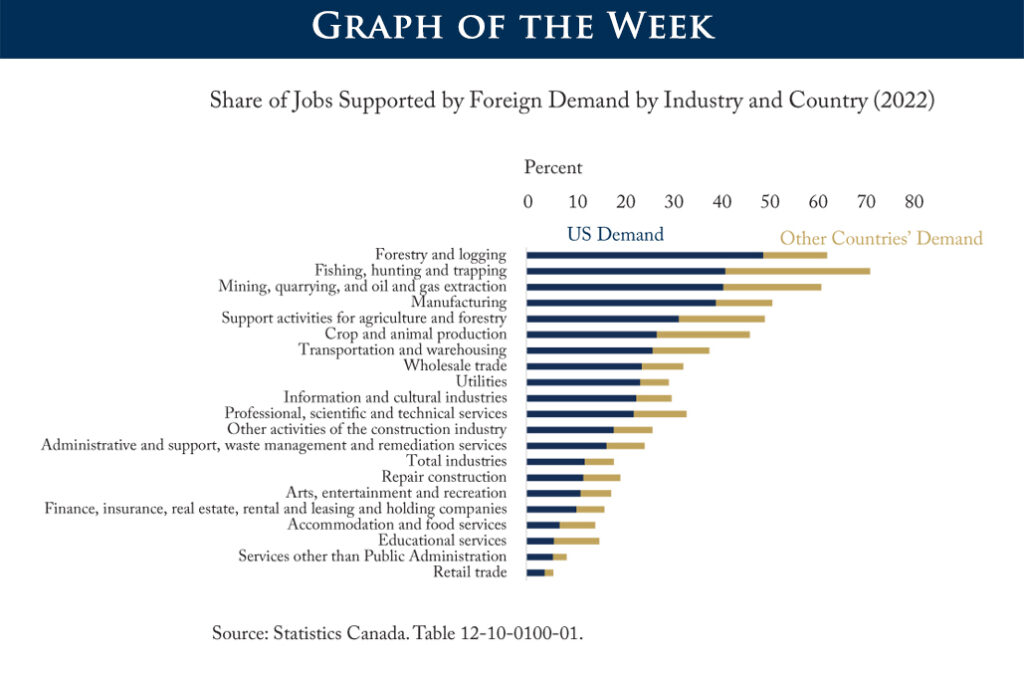
According to the latest available data, many Canadian industries rely heavily on US demand, with resource-based sectors being the most exposed. In 2022, nearly half of forestry and logging jobs (49.3 percent) depended on the US market, followed closely by fishing and hunting (41.4 percent), mining and oil and gas extraction (41.0 percent), and manufacturing […]
From: Christina Caron and Glen HodgsonTo: Economy observersDate: March 11, 2025Re: The Erosion of Natural Capital and Declining Productivity Growth As we discussed yesterday, labour productivity and multifactor productivity (MFP) growth rates have been declining in advanced economies for several decades, and the decline in labour productivity growth has now extended to emerging economies. While […]
Study in Brief In 2024, Canada’s labour market showed modest growth, with job creation continuing but lagging rapid population growth. This led to an increase in the unemployment rate, reflecting a mismatch between labour force expansion and job creation rather than a decline in sector-specific labour shortages. Ongoing challenges persist, such as declining labour productivity, […]
March 11, 2025 – Canada’s labour market faces mounting pressures that cannot be fixed merely by adding more workers, according to a new report from the C.D. Howe Institute. In the inaugural “2024 Labour Market Review: Challenges, Trends, and Policy Solutions for Canada,” authors Parisa Mahboubi and Tingting Zhang find that the rising unemployment rate […]
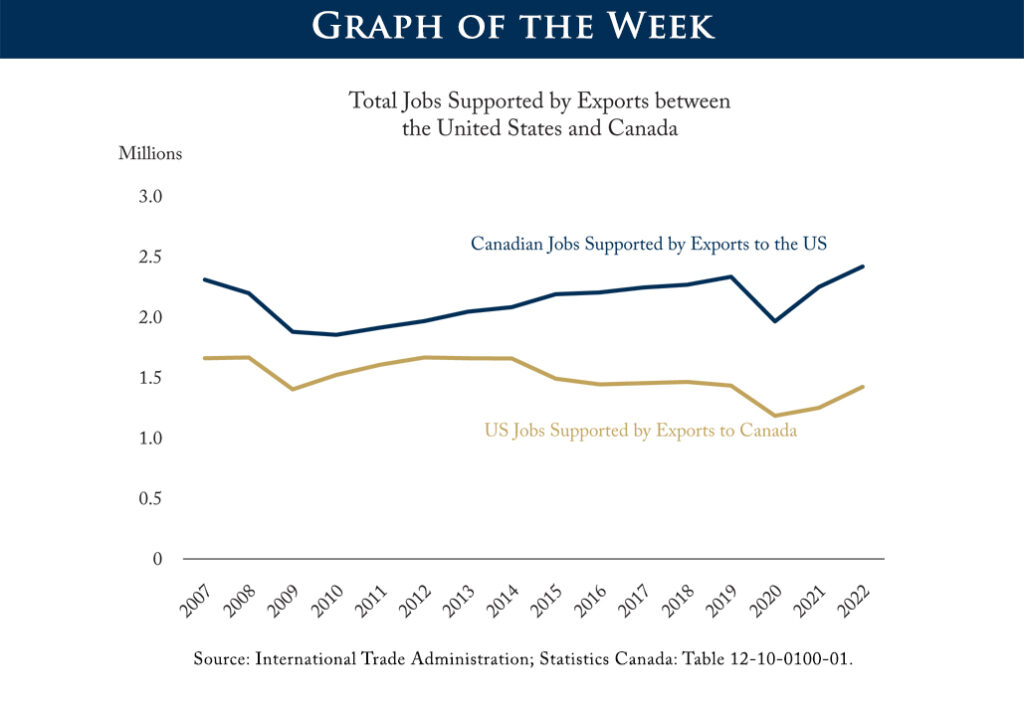
The total number of Canadian jobs tied to our exports to the US has grown over time, except during the 2008 financial crisis and the COVID-19 pandemic – though in both instances they rebounded quickly. While American jobs supported by US exports to Canada have declined slightly since 2014, they still total around 1.4 million. […]
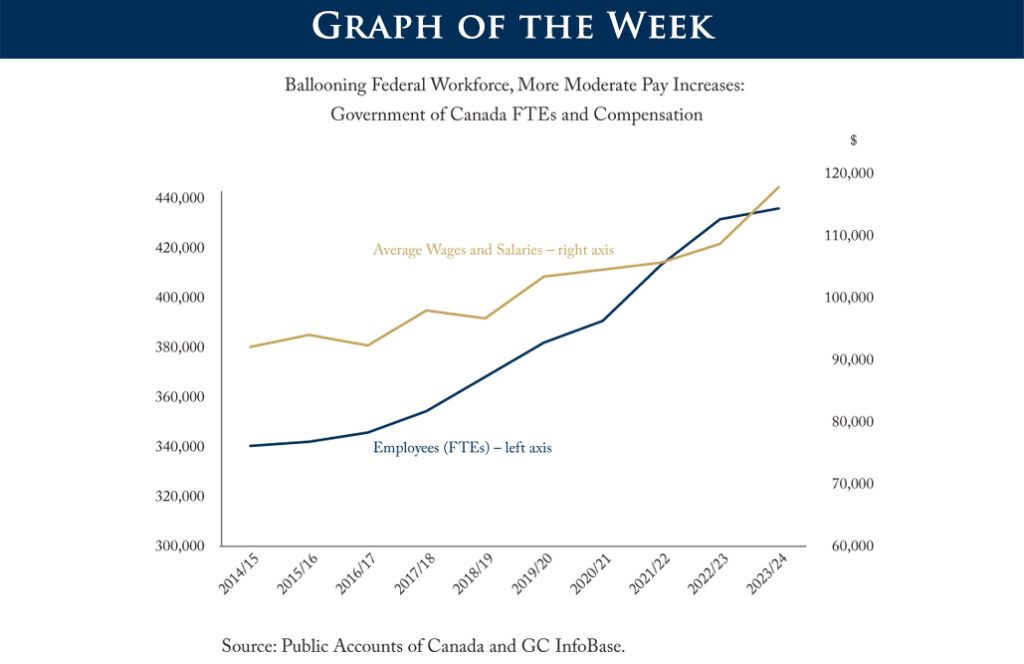
The number of federal government employees grew sharply from 340,000 in 2014/15 to nearly 440,000 in the most recent fiscal year. The rise in wages and salaries has grown at an average annual rate of 2.8 percent over the same period – a figure that, while more modest, surpasses the average annual rate of inflation […]
February 25, 2025 – Canada’s expansive immigration policy from 2016 to 2024 has expanded the labour force but has also increased demand for goods, services, and infrastructure, more likely sustaining or even increasing overall labour shortages rather than easing them, according to a new report from the C.D. Howe Institute. In “The Immigration Paradox: How […]
Membership Application
Interested in becoming a Member of the C.D. Howe Institute? Please fill out the application form below and our team will be in touch with next steps. Note that Membership is subject to approval.
"*" indicates required fields
Member Login
Not a Member yet? Visit our Membership page to learn more and apply.


 From: Parisa Mahboubi and Tingting ZhangTo: Canadian economic observersDate: March 26, 2025Re: We Have More Workers. Now We Have to Invest in Them As trade tensions with the United States escalate, putting tens of thousands of Canadian jobs at risk, our home-grown productivity problem continues to erode the country’s economic strength. Without a change of strategy, Canada faces […]
  In terms of national scores in reading, mathematics, and science among sampled students at age 15, Canada continues to rank among the top ten countries in the 2022 PISA survey. At first glance, one might conclude all is well. However, Canada’s national trends have consistently declined since initial benchmarking of the three subjects in the […]
  From: Pierre FortinTo: Labour force observersDate: March 21, 2025Re: Why More Immigration Didn’t Solve Canada’s Labour Shortages From 2015 to 2023, the federal government allowed immigration levels to increase fivefold, mostly through a significant rise in temporary immigration. By the end of 2024, Canada had three million non-permanent residents, representing 7.3 percent of the country’s population […]
  Published in the Financial Post As trade tensions with the United States escalate, putting tens of thousands of Canadian jobs at risk, our home-grown productivity problem continues to erode the country’s economic strength. Without a change of strategy, Canada faces stagnating wages, declining competitiveness, slowing GDP growth and eroding living standards. Our recent labour market review for […]
  According to the latest available data, many Canadian industries rely heavily on US demand, with resource-based sectors being the most exposed. In 2022, nearly half of forestry and logging jobs (49.3 percent) depended on the US market, followed closely by fishing and hunting (41.4 percent), mining and oil and gas extraction (41.0 percent), and manufacturing […]
  From: Christina Caron and Glen HodgsonTo: Economy observersDate: March 11, 2025Re: The Erosion of Natural Capital and Declining Productivity Growth As we discussed yesterday, labour productivity and multifactor productivity (MFP) growth rates have been declining in advanced economies for several decades, and the decline in labour productivity growth has now extended to emerging economies. While […]
  The total number of Canadian jobs tied to our exports to the US has grown over time, except during the 2008 financial crisis and the COVID-19 pandemic – though in both instances they rebounded quickly. While American jobs supported by US exports to Canada have declined slightly since 2014, they still total around 1.4 million. […]
  The number of federal government employees grew sharply from 340,000 in 2014/15 to nearly 440,000 in the most recent fiscal year. The rise in wages and salaries has grown at an average annual rate of 2.8 percent over the same period – a figure that, while more modest, surpasses the average annual rate of inflation […]