


Balyk, Livingston, Hastings-simon, Bishop – Unpacking Ottawa’s Ambitious Carbon Plan For Cars And Trucks
 To: Canadians concerned about carbon From: Joel Balyk, Brian Livingston, Sara Hastings-Simon and Grant Bishop Date: August 9, 2021 Re: Unpacking Ottawa’s Ambitious Carbon Plan for Cars and Trucks The federal government’s “strengthened climate plan,” projects a reduction of 213 megatonnes of greenhouse gas (GHG) emissions – or 30 percent of 2018 nationwide GHGs – by 2030. It seeks […]
Paying More For Less
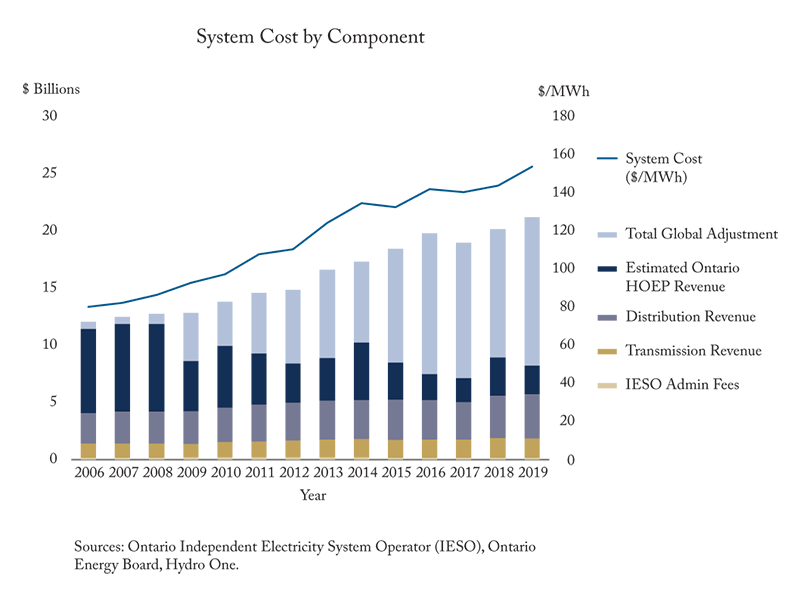 Ontario’s electricity sector has struggled with rising system costs for more than a decade. Not only have system costs been steadily increasing, the share of the costs that are directly related to the consumption of electricity have been steadily decreasing. Why? System Cost Share of Cost Taxpayer Support The province struck high-cost contracts with higher […]
Driving Ambitions: The Implications of Decarbonizing the Transportation Sector by 2030
 Zero-emission vehicle sales must reach 70 percent by 2030 to hit federal emissions targets: C.D. Howe Institute A complete transformation of Canada’s passenger vehicle market – with 70 – 75 percent of sales being of Zero-Emission Vehicles (ZEVs) by 2030 – is required in order to hit Ottawa’s emissions targets. This compares to the current […]
Glen Hodgson – How Is Hydro One Performing On Crown Governance?
 From: Glen Hodgson To: Overseers of Crown Corporations Date: July 8, 2021 Re: How is Hydro One Performing on Crown Governance? Canada’s Crown corporations form a major part of the economy, but rarely draw detailed scrutiny. In his latest C.D. Howe Institute Commentary and in this special Intelligence Memo series, Fellow-in-Residence Glen Hodgson assesses governance at Hydro One, a publicly […]
Power Surge: The Causes Of (and Solutions To) Ontario’s Electricity Price Rise Since 2006 – Globe And Mail Op-ed
Ontario’s electricity sector has struggled with rising system costs for more than a decade. The main solution governments of all stripes have come up with is to shift costs to taxpayers. These subsidies for electricity use now cost taxpayers more than what the province spends on long-term care. It’s time for some proper fixes.
The crux of the problem is the increase in the cost of electricity supply from high-cost contracts signed by the province. At the same time, Ontario has consumed less electricity than forecast by the government when it struck the contracts. With high fixed costs in contracts spread over less demand, the result has been upward pressure on prices, mitigated mainly by your tax dollars.
How can…
Power Surge: The Causes of (and Solutions to) Ontario’s Electricity Price Rise Since 2006
 Taxpayer Electricity Subsidies Out of Control Ontario’s electricity sector has struggled with rising system costs for more than a decade. Why? The crux of the problem are increases in the cost of supply from high-cost contracts spread over less electricity consumption than forecast when the contracts were struck. The result has been upward pressure on […]
Beugin, Shaffer – The Climate Policy Certainty Gap And How To Fill It
 From: Dale Beugin and Blake Shaffer To: Infrastructure Minister Catherine McKenna Date: June 4, 2021 Re: The Climate Policy Certainty Gap and How to Fill It Canada now has a pan-Canadian carbon price that is due to rise to $170 per tonne by 2030. Yet some firms appear to be holding off on investing capital in expensive, long-lived, […]
Dillon, Gullo – Six Principles To Help Lead Canada To A Net-zero Economy
 From: John Dillon and Michael Gullo To: Canada’s Policymakers Date: May 27, 2021 Re: Six Principles to Help Lead Canada to a Net-Zero Economy Climate change represents one of the most urgent public policy challenges facing Canadians today. Fortunately, we have the expertise, the resources and the know-how to achieve the government’s goal of net-zero emissions by 2050. It […]
Peter Van Dijk – Why Public Sector Entities Must Be Allowed To Include Natural Assets In Financial Statements
 From: Peter van Dijk To: Canadians Concerned about Recognition of Natural Assets Date: May 20, 2021 Re: Why Public Sector Entities Must Be Allowed to Include Natural Assets in Financial Statements Canada’s wealth of natural capital – forests, wetlands, rivers, lakes and grasslands – deliver critical benefits to support our economy and our society. Despite their value, these natural […]
Lawrence Herman – Line 5: A White House Missing In Action
 From: Lawrence Herman To: Prime Minister Justin Trudeau Date: May 18, 2021 Re: Line 5: A White House Missing in Action The battle over Enbridge Line 5 – unfolding in a Michigan courtroom – shows how declarations of friendship between Canadian and US governments are hostage to local politics. Last February, the Prime Minister and the US President […]
Biden should step up for Canada on Line 5 – Globe and Mail Op-Ed
The battle over Enbridge Line 5 – unfolding in a Michigan courtroom – shows how declarations of friendship between Canadian and American governments are hostage to local politics.
This past February, the Prime Minister and the U.S. President concluded a Roadmap for a Renewed U.S.-Canada Partnership. While the Roadmap doesn’t refer to pipeline issues, in spirit and intent it should prevent actions by the state of Michigan that will seriously harm broad Canadian interests. The Line 5 dispute is of a different order than trade cases involving discrete sectors such as softwood lumber or dairy products. Much different.
Of critical importance, Line 5 is governed by a binding treaty between Canada and the United States,…
Neil Alexander – Creating A Successful Small Modular Reactor Business In Canada
 From: Neil Alexander To: Canadian Nuclear Watchers Date: May 11, 2021 Re: Creating a Successful Small Modular Reactor Business in Canada Last month, Alberta signed on to the existing memorandum of understanding between Ontario, Saskatchewan and New Brunswick signalling its desire to collaborate on the deployment of Small Modular Reactors (SMR). It’s the latest step in Canada’s useful progress […]