


C.D. Howe Institute Monetary Policy Council Calls for Bank of Canada to Hold Overnight Rate at 4.50 Percent through October, Cut to 4.00 Percent by April of 2024
April 6, 2023 – The C.D. Howe Institute’s Monetary Policy Council (MPC) recommends that the Bank of Canada hold its target for the overnight rate, its benchmark policy interest rate, at 4.50 percent on April 12th, and keep it at that level for the next six months. By April of 2024, the Council recommends a cut to 4.00 percent.
The MPC provides an independent assessment of the monetary stance consistent with the Bank of Canada’s 2 percent inflation target. William Robson, the Institute’s CEO, chairs the Council.
Council members make recommendations for the Bank of Canada’s upcoming interest-rate announcement, the subsequent announcement, and the announcements six months and one year ahead. The Council’s…
Pooling Piggybanks: The Case for Combining Ontario’s Municipal Reserves
 Public-sector investment funds (especially pension funds) have been increasingly pooled and managed by investment management firms in Ontario. Pooled asset management generates a net benefit to public-sector spending patterns by realizing benefits from economies of scale, including reducing costs associated with the duplication of fund management while also enhancing risk management. However, a focus on […]
Stablecoin could be really useful money so let’s regulate it like money – Financial Post Op-Ed
The knock-on effects from the failure of Silicon Valley Bank also spread to stablecoins. The day after SVB’s failure, USDC, the world’s second-largest stablecoin, announced it had $US3 billion on deposit with SVB and promptly, but briefly, lost its peg to the U.S. dollar. Some people will see this as another nail in stablecoin’s coffin. In our view, it’s another example of why the federal government needs to establish a legal and regulatory framework for stablecoins that seek to serve as money. If it aims to be money, and it could be money, let’s regulate it like money.
Bitcoin may get all the headlines, but without any asset backing it, it has no future as money. Stablecoins do. They are crypto assets in that they…
Kronick, Munn – Six Banking Lessons From the Moment
 From: Jeremy M. Kronick and Duncan T. Munn To: Financial Sector Regulators Date: March 27, 2023 Re: Six Banking Lessons From the Moment With the implosion of systemically important Credit Suisse, the reverberations from Silicon Valley Bank’s failure continue to rattle regulators, investors, and Canadians alike. What is the risk of further financial contagion, globally and for Canadians […]
Jeremy M. Kronick – Five Policies to Scale our SMEs
 From: Jeremy M. Kronick To: Canada’s Governments Date: March 20, 2023 Re: Five Policies to Scale our SMEs These days, it often feels like we don’t agree on much. But higher income growth is one thing all Canadians should be able to support. One way to achieve this growth is to see young businesses grow into large ones. While […]
Fallout from Silicon Valley Bank with Peter Hall

What does the collapse of Silicon Valley Bank in California mean for Canada? In episode five of the C.D. Howe Institute Podcast, Elevate Export Finance’s Peter Hall tells host Michael Hainsworth that SVB can learn a lot from our financial expertise, and that Canadian banks may benefit from the need for capital in Silicon Valley.
Duncan Munn – The SVB Collapse was a Tale Foretold
 From: Duncan Munn To: Canadians Concerned About Financial Stability Date: March 14, 2023 Re: The SVB Collapse was a Tale Foretold It is said that crises happen slowly at first, and then all at once. Silicon Valley Bank’s shocking 48-hour collapse took many by surprise. Yet trouble signs were apparent, most notably, the classic asset liability mismatch that ultimately […]
Bailliu, Kronick, Wu – Why Safe Asset Shortages Matter (When They Occur)
 From: Jeannine N. Bailliu, Jeremy M. Kronick and Wendy Wu To: Canadians Concerned about Financial Markets Date: February 23, 2023 Re: Why Safe Asset Shortages Matter (When They Occur) Safe assets – debt instruments that are expected to preserve their nominal value during both good times and bad, and have ample liquidity – play a vital role in the […]
Stablecoins: Sailing without a Rudder
 Stablecoins are cryptographic (crypto) assets that are widely used in decentralized finance (DeFi) applications and crypto-asset trading strategies. Stablecoins offer the prospect that their “stable value” could potentially increase their use and desirability as a crypto medium of exchange by exploiting the benefits of blockchain technology, such as composability (integrating code from other products and […]
Jeremy Kronick on BNN – Explaining the Bank of Canada’s Latest Transparency Experiment
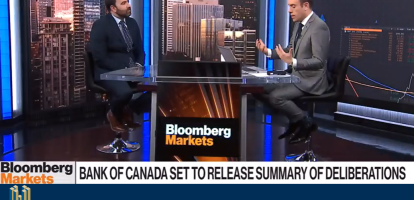
The Bank of Canada released minutes of its January 25 interest rate meeting this week. Our Jeremy Kronick outlined the benefits and risks of this first-ever initiative for a BNN Bloomberg television audience.
Fiscal and Monetary Policy Need to Work Together – Financial Post Op-Ed
Since starting its fight against inflation last March the Bank of Canada has been focused on little else. That is in stark contrast with many of the country’s finance ministers, who have raised spending and increased government hiring. Coordination between our monetary and fiscal authorities would make the Bank’s job a lot easier. Failing that, however, the Bank should continue do what is necessary to get inflation back to target.
The onset of the pandemic saw unprecedented coordination between fiscal and monetary authorities around the globe, including in this country. The Bank of Canada lowered its policy rate to its effective lower bound (0.25 per cent) and then turned to less conventional monetary…
The Global Safe Asset Shortage: Why it Matters for Canada
 In the decade leading up to the pandemic, safe assets did not keep pace with global demand. The supply of high-grade government bonds in advanced economies was constrained because budget deficits were declining. At the same time, the demand for these assets increased due to the aging population, more restrictive regulations on financial institutions (requiring […]