


Where’s the oil boom? Why Alberta’s recent good fortune is mostly a mirage – Globe and Mail Op-Ed
Alberta has earned a reputation over many decades for being a boom-bust economy. Strong oil demand and high prices have created boom times for jobs, incomes, investment and government revenues, while weak demand and falling prices have meant a slowdown or even recession on occasion.
But now, global demand for oil is again rising and prices are high, yet more oil-production revenue is not translating into a sustained economic boom for Alberta.
The province’s economy grew by 4.8 per cent in real terms (with inflation removed) in 2021. A budget surplus has financed or paid for Premier Danielle Smith’s latest inflation-relief handouts. While that sounds good, there was no oil boom; this growth is simply part of…
Glen Hodgson – When Will Canada Adopt Better Flood Risk Management?
 From: Glen Hodgson To: Canadian Flood Watchers Date: November 22, 2022 Re: When Will Canada Adopt Better Flood Risk Management? Hurricane Fiona hit Atlantic Canada and eastern Quebec very hard. Fiona’s severe coastal flooding and powerful winds destroyed houses, commercial property and infrastructure, with lives lost and a lengthy recovery period ahead. Insured losses are estimated at up to […]
 Power When You Need It: The Case for Small Nuclear Reactors
 The 2021 Canadian Net-Zero Emissions Accountability Act requires Canada to achieve “net zero” greenhouse gas emissions (GHGs) by 2050. An important component of the goal is that the power sector realize “net zero” by 2050. The Canada Energy Regulator (CER) has developed a net-zero projection for the power sector, emphasizing renewables (hydro, wind, solar). Wind and solar […]
 Charles DeLand — Another LNG opportunity for Canada to grasp
 To: Canadian Climate and Energy Infrastructure Watchers From: Charles DeLand Date: October 25, 2022 Re: Another LNG opportunity for Canada to grasp German chancellor Olaf Sholz came to Canada late this summer seeking Canadian liquefied natural gas (LNG). He left empty-handed, not for lack of supply but because Canada lacks the infrastructure to deliver it. And mixed government messaging […]
 Can We Really Retrofit One House Every Minute?
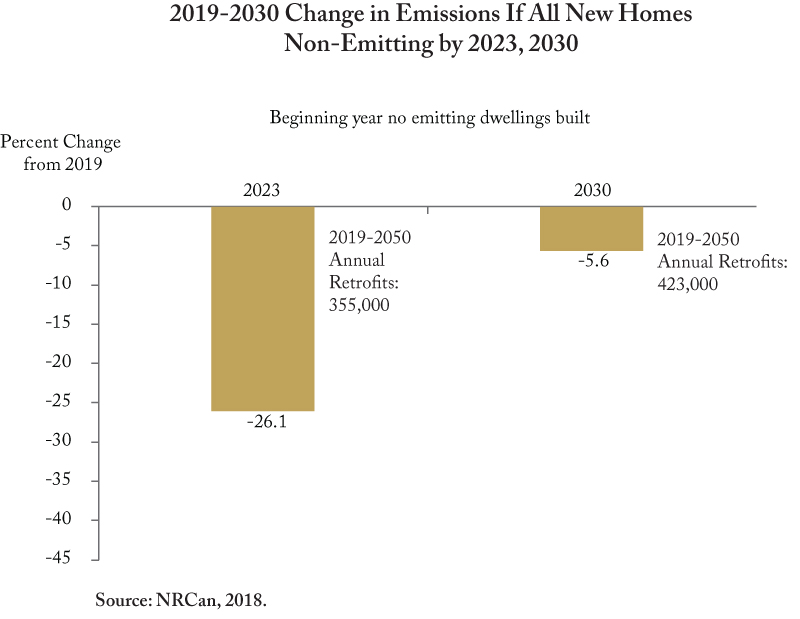 Roughly 5.3 million Canadian homes are electrified now, leaving 10.2 million to be retrofitted. And this number will grow as more homes get built for a growing population. A total of 13.5 million homes need to be electrified by 2050. On average that’s almost 422,600 homes that will need to be retrofitted each year (1,158 […]
 Charles DeLand – Ottawa’s Unrealistic Building Emission Reduction Targets
 To: The Honourable Steven Guilbeault, Minister of Environment and Climate Change CC: The Honourable Jonathan Wilkinson, Minister of Natural Resources From: Charles DeLand Date: October 17, 2022 Re: Ottawa’s Unrealistic Building Emission Reduction Targets The federal government’s Emissions Reduction Plan calls for economy-wide greenhouse gas (GHG) reductions of 40 to 45 percent below 2005 levels by 2030. In particular, it […]
 The Scale of Canada’s Home Retrofit Challenge
Heating, cooling and lighting Canadian buildings takes a lot of energy. In 2019, commercial and residential buildings together were responsible for 25 percent of total energy consumption, more than the entire transportation sector. While this energy keeps people comfortable and goods at the right temperature, it creates greenhouse gas emissions. The federal government’s 2030 Emissions […]Ottawa’s wildly unrealistic net-zero goal for buildings – Financial Post Op-Ed
The federal government’s Emission Reduction Plan, which it published in July, calls for economy-wide greenhouse gas reductions of 40 to 45 per cent below 2005 levels by 2030. In particular, it projects emissions from homes and commercial buildings that will fall 37 per cent from 2005 levels. Judging by reasonable estimates of what it would take to achieve this, however, that goal appears wildly unrealistic.
Greenhouse gas (GHG) emissions from buildings are the third largest source of emissions in Canada. (The first two are oil and gas and transportation) In contrast to some other sectors of the economy and despite better technology and efficiency, GHGs from buildings have actually increased since 2005, partly because the…
Hodgson, Hodgson – Federal Purchases of Direct Air Capture Would Help Build a Viable Market
 From: Glen Hodgson and David Hodgson To: Canadians Concerned About Climate Targets Date: October 3, 2022 Re: Federal Purchases of Direct Air Capture Would Help Build a Viable Market Achieving net-zero emissions by 2050 will be difficult, given the large stock of capital engaged in the production and use of fossil fuels. Carbon capture has become a […]
 S4 E14: Only Hot Air? with Charles DeLand

Ottawa wants to slash greenhouse gas emissions from Canadian home heating. But is the goal little more than hot air? The C.D. Howe Institute’s Charles DeLand tells host Michael Hainsworth that cutting emissions to 0% by 2050 will cost more than $6 billion a year and we need to start renovating homes now.
Only Hot Air? The Implications of Replacing Gas and Oil in Canadian Homes
 Canadian homes emit about six percent of Canada’s total greenhouse gas (GHG) emissions. The Federal government aims to bring down 2030 building emissions by 42 percent compared to 2019, with the entire economy producing net zero emissions by 2050. This report examines current sources of emissions from Canadian homes and presents a scenario in which […]
 Charles DeLand – What is the Actual Plan? Long-lived Investments Need Consistent Signals
 From: Charles DeLand To: Canadians Concerned about Prosperity Date: August 15, 2022 Re: What is the Actual Plan? Long-lived Investments Need Consistent Signals Russia’s Ukraine invasion has grabbed the world’s attention and understandably drawn focus to energy security. Despite overwhelming and vocal political support for Ukraine, governments are still only offering mixed signals and shifting […]